He does not want a legacy; he only asks for change
At 82-years-old, he is still getting arrested for the climate crisis.
By Birdi Diehl
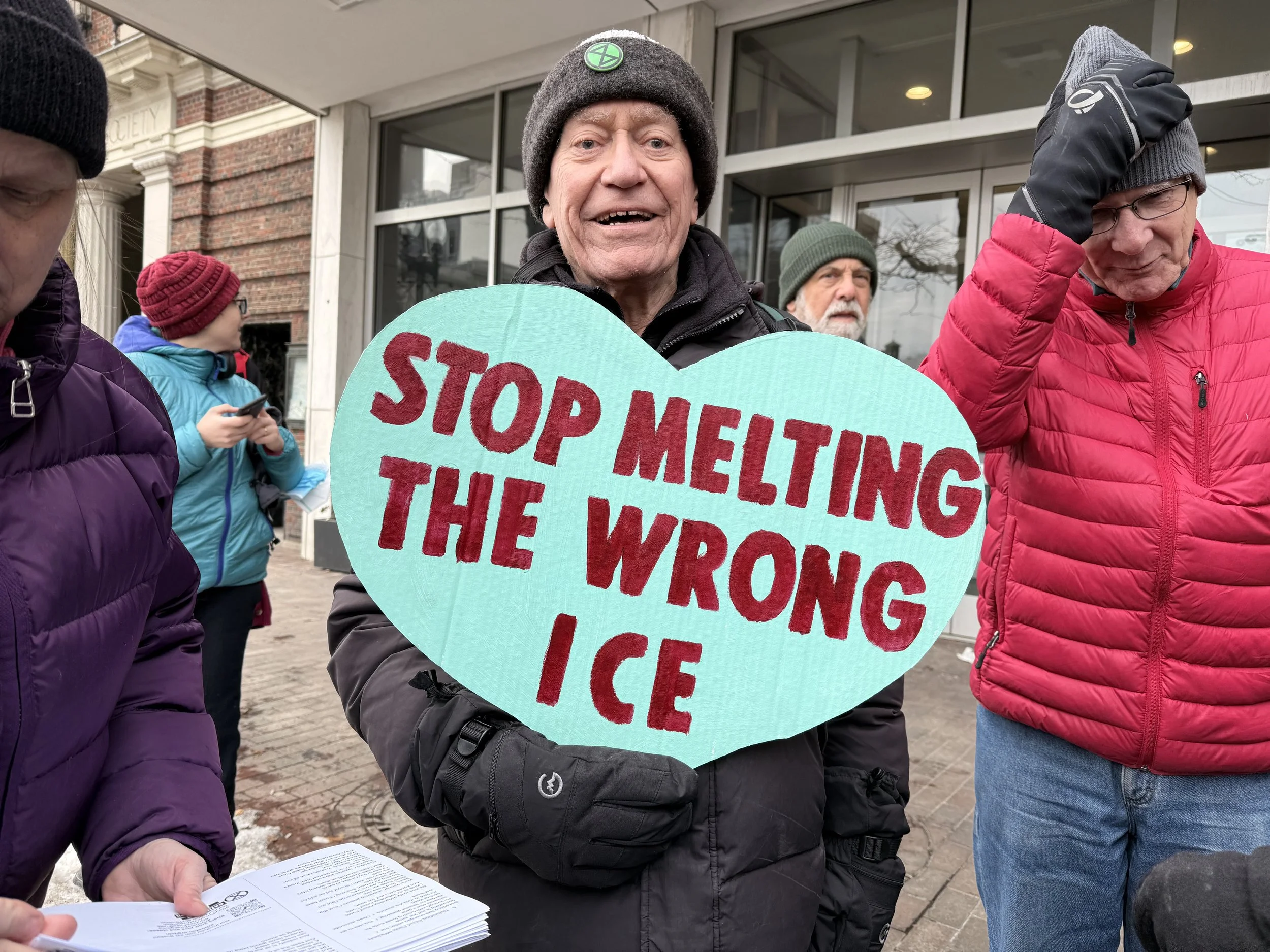
Peter Watson, 82, holding signage at a protest about moving money away from big, corporate banks in the city of Cambridge. Photo by Birdi Diehl
On a gray morning at the Massachusetts State House, Peter Watson, 82, stands with fellow, elder protestors on the brick plaza beneath the golden dome. He is wearing a heavy coat, gloves and beanie to ward against a damp chill. A few inches above five feet, his smile lines and deep-set wrinkles frame a face that looks resolute. But his kind eyes and the way he shakes a hand by cupping the other person’s between his suggest that he is gentle and tender-hearted.
As the faint smell of exhaust drifts up from Beacon Street, sometimes the protestors are chanting “WE NEED CLEAN AIR, NOT ANOTHER BILLIONAIRE,” sometimes they are standing quietly, trying to use their presence as defiance.
Cars stream past in a steady, indifferent rhythm with their engines humming, tires whispering against the pavement. Tourists approach in bursts, drawn not by the landmark but the people posted in front of it. Most, though, keep moving.
Week after week, Watson returns anyway for the two hour shift. He is a climate protestor with a yearslong message to “stop fossil fuel infrastructure,” but mostly, he is one of the people who keep showing up.
His path to climate activism runs through decades of art, teaching, travel and protest, from performing theater in India to teaching it in both England and western Massachusetts. Now, his life of creativity has become part of a broader commitment to confront the climate crisis, one he sees as urgent for present and future generations. He is still returning to the State House, raising the larger stakes question about whether ordinary people can pressure leaders to respond before the crisis deepens further. Only a serious event is enough to keep Watson from his weekly returns.
Early this year, his body interrupted his activism. Walking to a local Whole Foods, he suddenly felt faint. He grabbed a lamppost, lowered himself to the ground “somewhat gracefully,” and lost consciousness. He woke up to a small crowd of paramedics and concerned passersby gathered around him.
Doctors discovered a blockage near his heart, leading to the placement of five stents at Brigham and Women’s Hospital in Boston. Weeks later, it happened again, which led to another surgery. Now, with additional stents in place, he has completed rehab and returned to regular exercise, where he is “feeling very fit” and is committed to “just keeping going.” Not even a heart attack at his age can stop his perseverance to make a difference with climate activism.
“There wasn’t a moment when I felt afraid,” he says and credits his lack of fearfulness to his daily meditation practice.
But that experience sharpened a blade that was already a presence in his life: an awareness of time, of limits, of what still needs to be done.
After he saw a post online about an introductory meeting, Watson joined Extinction Rebellion Boston (XR Boston), a chapter of an international climate protest organization. Extinction Rebellion, which started in the United Kingdom, works to push the government to do more “in the midst of a climate and ecological breakdown,” according to its website. They believe the world is “in the midst of a mass extinction of our own making and our governments are not doing enough to protect their citizens, our resources, our biodiversity, our planet, and our future.”
Earth experienced its fifth-warmest February on record this year, with temperatures at 34.68 °F above pre-industrial levels, according to Sky News, even with the blizzards that hit Boston these last few months.
Watson says the snow will melt. Meanwhile, “the Earth is still warming.”
He joined the organization about seven years ago, and slowly became more active. His first act of climate activism in the United States was outside the Brazilian consulate in downtown Boston to protest Brazilian President Jair Bolsonaro's destruction of the Amazon forests, where the protest was a series of speeches and chants shared with other members of the organization.
At the State House, they return to the same place, talking to people walking past, and asking lawmakers to move faster. Watson helps organize these demonstrations as the group’s self-proclaimed “nagger-in-chief.”
Watson is “the man who keeps showing up,” says Jamie McGonagill, XR Boston’s media and messaging coordinator.
Watson and other XR Boston members also want more young people at XR Boston events.
“A lot of our members are older, a lot of them retired, and they have time on their hands that they did not have while they were still actively involved in a career capacity,” says McGonagill. “Those are some of my favorite members to work with because they are so passionate.”
In his own life, Watson is one of the many elders who are holding their ground in climate resistance as a moral obligation for future generations. That sentiment carries to other XR Boston members like Miranda Dotson. She believes that people not showing up is not based on a lack of ability to attend, but a lack of will.
Dotson believes that people should stop using the world “can’t” when it comes to either participating in protest against the climate crisis or not. By saying the word “won’t” in its place, it erases the fact that someone will not do something.
Watson admits he is “prepared for the collapse” of the world, even if he may not live to see it. He believes the solution to the climate crisis requires a fundamental shift in how society operates, with a move away from what he sees as a deeply entrenched, extractive capitalist mindset.
He worries that the current governmental systems are not pushing people away from ignoring the climate crisis. Yet, above it all, Watson still holds onto a distant optimism that change, no matter how difficult or delayed, can still happen.
Watson believes the protests are working, but not necessarily because of legislative achievements. Instead, he measures impact in the encounters he has with passersby or tourists, often from overseas. For Watson, these are the moments that feel like he is making a “solid difference,” where the people he speaks with are “being made aware for the first time of the depth and breadth of the climate crisis.”
Those small interactions are the real force behind change for Watson. He imagines the work he does at the State House as an irritant that will not go away, or a “slow, slow drip of a stalactite” that eventually reshapes the rock.
“It was a reminder all the time,” says Watson. “Are you present? Are you here? Are you taking notice?”
Watson grew up in Bristol, England in the 1950s, surrounded by the open air. His mother was an avid gardener and introduced him to flowers. While she loaded up the car for weekend drives into the Cotswolds, Watson got to see rolling limestone hills stretching over the Severn Valley. They picnicked atop the downs with Neolithic ramparts around them that had been standing for centuries.
“That was magical to me,” said Watson. “We had friends who lived in the country and had a country cottage. We would go in the spring, picking primroses along the side of the road, and in the fall, blackberries, tons and tons of blackberries.”
At about 11 years old, he went with his family on a trip to Scotland, where they traveled through Glencoe and across the Isle of Skye. The scenery presented dramatic mountains and glens that deepened his sense of awe and a nostalgia that is “not confined to childhood.”
He protested the Vietnam War in London, England, in the early 1960s, when he was in his twenties, where he remembers “huge crowds outside the American Embassy” and “throwing rotten tomatoes and eggs…at the building.”
He got a “taste” of theater as a child from his father, who built stages and set elements. As an adult, he taught theater, arts and drama at Durrants High School in Rickmansworth, Hertfordshire, England, from 1964 to 1971, and later taught at Furzedown College in London from 1974 to 1976. It came to a stop when Margaret Thatcher, as the Minister of Education in England, decided that colleges would “no longer be teaching arts.”
“She wanted [teachers] teaching sciences,” says Watson. “So, we were kind of given a small handshake and told to go away.”
In 1980, he flew to Mumbai, India, where he got “hooked up” with a theater group that was touring around the country performing Shakespeare and comedy. A troupe he deemed an “unlikely collection of people,” he played a part in A Midsummer Night’s Dream, Twelfth Night, and performed in a series of comedy skits as part of the entertainment at the Bollywood Oscars.
While touring, he met the person who became his wife, and later ex-wife, Sonam Rose, with whom he is still close and sees often. She was from Boston, where he moved in 1984. He applied for his green card and, after approval, got “sidetracked into doing decorative painting” around the greater Boston area, where “tons of people…wanted sort of strange things painted on their walls.”
As he got older and as finances became increasingly difficult, he went back to teaching in the schools. He had friends in the western Massachusetts suburbs, and his daughter participated at Concord Youth Theater. He met people working at the private schools around the area and landed a job in 2006 at Dana Hall School in Wellesley, Massachusetts, where he now resides. He taught drama and theater arts there for 12 years until he retired in 2017.
After moving to the United States, the landscapes that defined his childhood became just as meaningful as the landscapes of his later life. In the late 1980s, Watson drove coast to coast from Santa Monica to Atlantic City, through the Grand Canyon, the Painted Desert, Joshua Tree National Park, absorbing the vastness of the country mile by mile. Watson took his daughter, Haley Watson, on camping trips in Maine’s Acadia National Park from the late 1990s to early 2000s, where even at 38, the steep climb on the Beehive Trail is burned into her mind.
Watson best describes his daughter as a “forward looking, hip person” who lives in Kansas City, Missouri. She is currently a restaurant manager and is working to become a sommelier. Her dream, however, was to go into theater, where she went to school in New York and studied it, waiting for five years to try and get a break that never came.
As she got older, the closeness with nature her father inspired in her and the state of the world began to clash. She never thought much about having children but the Trump administration, and its cuts to important policies, pushed her to a conclusion.
In about 2018 or 2019, she made a firm decision to never have children.
She told the comment to her father in passing, and honestly did not think much of saying it. Yet, Watson deems it as one of his driving reasons for his climate protest, which made him become “very passionate.”
“You do not know how much weight something you say is necessarily going to hold towards somebody else,” says Haley Watson. “I do not even really remember saying it [to my father], but he heard it and took that as his drive [for his participation in] Extinction Rebellion Boston.”
Watson has taken that passion and put himself directly in the path of arrest. At Hanscom Air Field two years ago, activists protested private jet use, and he was one of them. He says he did not intend to be arrested that day, but knew it was a possibility, saying it “sounded like a bit of an adventure.”
Rain poured down on the group of activists standing exposed on the tarmac, soaked through within minutes. After about 20 minutes, security lingered nearby but did not intervene.
But then they heard the sirens, barely audible over the cheers of dozens gathered.
A police car sped across the field. Watson thought “they would give [them] a warning.”
Instead, the officer jumped out of the car and said everyone was under arrest. Watson’s group, along with others, was handcuffed and made to sit on the wet curb, drenched and surrounded by police. Despite the circumstances, the mood remained unexpectedly buoyant, despite later being charged with trespassing and civil disobedience. The person to thank for the “positivity,” according to XR Boston members Jenny Allen and Allen McGonagill, was Watson.
“I remember he was being led away and I was checking to see if Peter was okay,” said Jamie McGonagill. “And he was still smiling as he walked to the police car…It uplifted everybody around him. It makes the hard work so much easier, and it makes the easy work so much more fulfilling.”
The movement also offers Watson connections. The group at the State House, and other members of the climate organization, have become a kind of chosen family. They check in on each other, and when Watson had his heart attack, that support blossomed into deep friendships. Stewart Clements, a fellow XR Boston member and very close friend, says he would “pretty well do anything for” him.
“He is one of the people who did things right,” says Parke Wilde, an XR Boston member. “And that includes both the work of taking action and objecting to a great wrong in this time of climate crisis, but it also includes doing so with a sense of artfulness…joy.”
Watson is not attached to leaving a legacy. What matters more is something quieter: being remembered with warmth, the sense that his presence made even a small difference in the lives of others, the balance of doing what he can and most importantly, hope coupled with humor.
“Hopefully this is the prologue, not the epilogue,” jokes Watson.
Watson’s lightness and resolve reflect the road he sees ahead, undefined by a single turning point but committed to how the story unfolds. The act of continuing still holds meaning, and most importantly, the routine of his day, which his daughter describes as “monk-like.”
Often, he wakes up around 5 a.m. or 6 a.m., when the sky is still slate gray and quiet. He places the kettle on for a cup of green and lemon tea, then sits in still silence for 20 minutes, sometimes 30, to meditate before the rest of the world rises with him.
After comes breakfast: a boiled egg, a slice of rye toast, and a bowl of yogurt with fruit. He would take a three-mile walk through his neighborhood, or, if the weather does not permit, he might head to the senior center gym to walk on the treadmill. By midday, he is back home, ready for lunch (usually a salad) and sets out on his newest venture of relearning the piano.
He is reteaching himself through online courses, learning to pluck out pop songs and rock progressions by ear. He wants to “leave the classics to Yuja Wang” but takes inspiration from Jacob Collier, a young British multi-instrumentalist whose layered harmonies fill his home.
This daily ritual is what he now cherishes at the age of 82: a soft beginning and middle that steadies him for whatever life holds.
“I would love the final chapters to be about myself successfully finding a way to move the needle on the climate crisis,” says Watson. “If no such major breakthrough happens, I’m also happy for the final chapter to wind down with more of the same.”
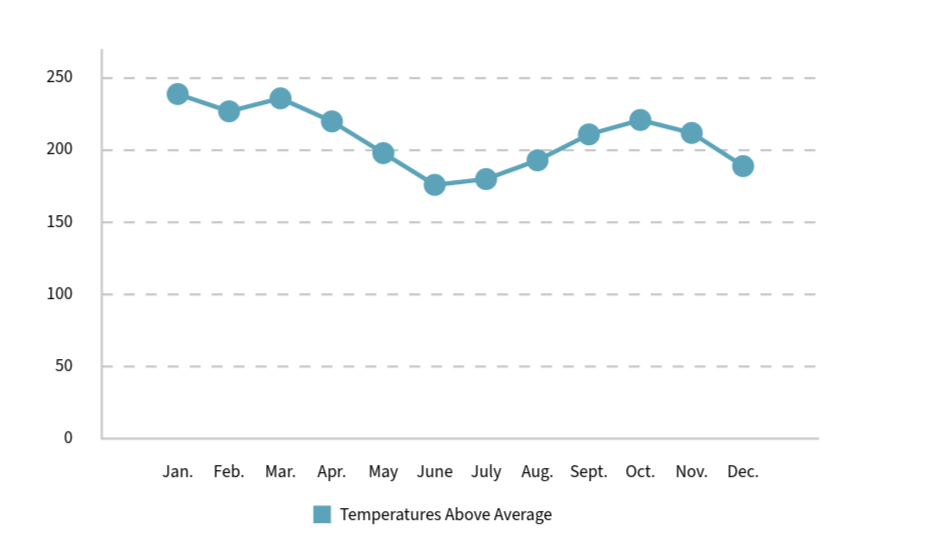
For the year of 2025, listed temperatures per month show by how much they were above average, where 1°F (of change) equals 100 on the graph. Graphic by Birdi Diehl
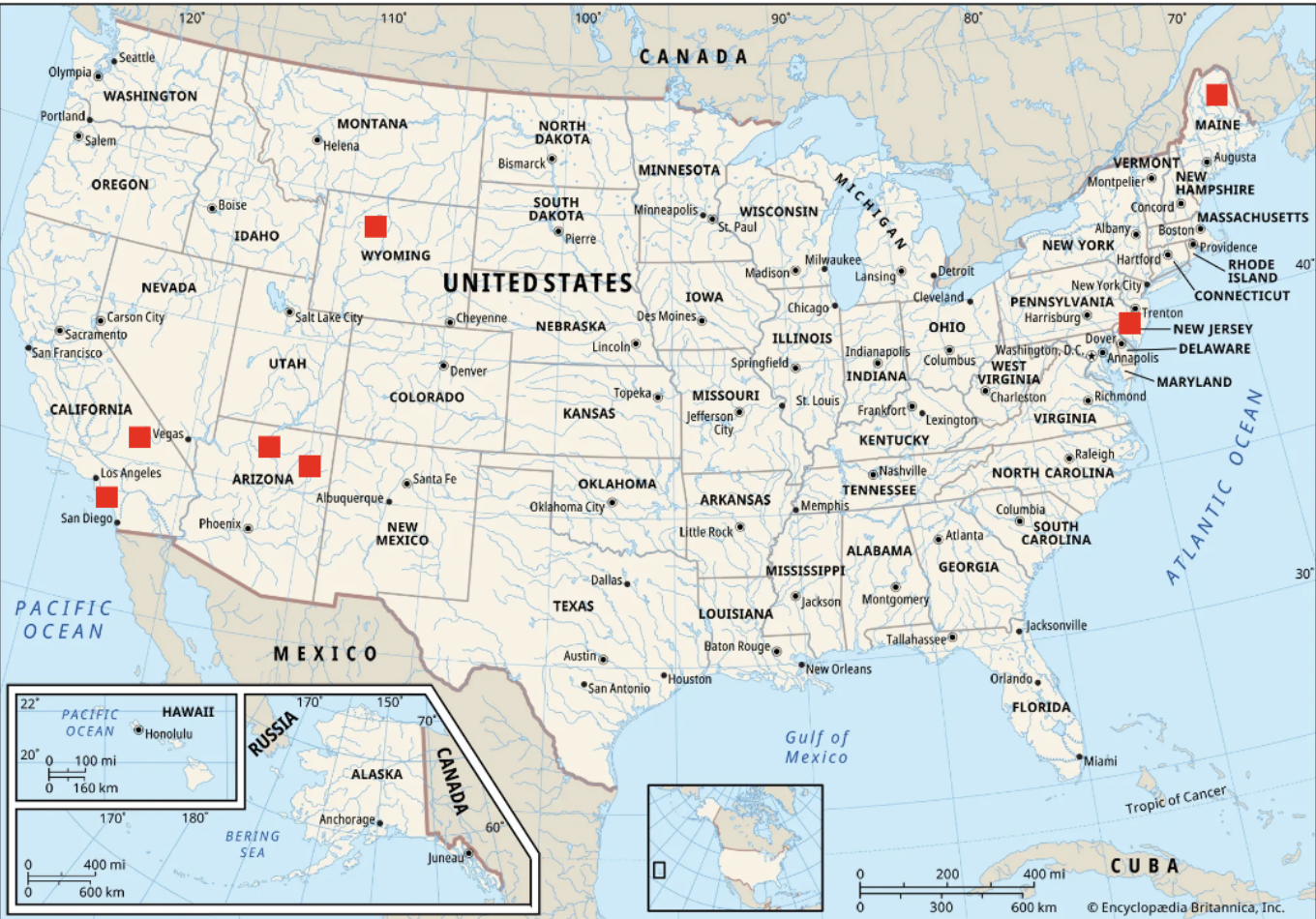
Red dots on graphic show specifically where Watson was traveling during the 1980s. Graphic by Birdi Diehl with the map from Britannica